What Is an On-Site Orthodontic Consulting Visit?
An on-site orthodontic consulting visit is a full day, or two, when a consultant works inside your practice, observing your systems, your team, and your patient flow while you see patients on a normal schedule. Nothing is staged. The visit ends with prioritized recommendations your team can start using immediately.
The observation happens live, with real families in your chairs, and it runs one or more full patient days depending on the size of your team and the number of departments involved.
That’s the core difference between an on-site visit and remote coaching. Remote work relies on what you report, meaning your numbers, your impressions, and your sense of where things break down. An in-office observation captures what actually happens at the front desk at 8:42 a.m., how long a parent waits before someone greets them, and what your treatment coordinator says right before she presents fees.
A typical visit covers the new patient experience from first phone call to signed contract, scheduling and template design, conversion and case starts, treatment coordination, clinical flow, and how your team communicates with each other during a busy day.
The visit doesn’t end with a checklist that could apply to any office. It ends with prioritized recommendations, ranked by what will move your practice fastest, plus an action plan your team can actually follow on Monday morning.
Amanda Floyd Consulting is the private consulting firm led by Amanda Floyd, COO of Fishbein Orthodontics, and Dr. Ben Fishbein, orthodontist and practice owner. They own and operate Fishbein Orthodontics, and Fishbein Fundamentals is the firm’s flagship in-office course held at that same practice. Every visit Amanda Floyd Consulting runs is built around systems already working inside a high-volume orthodontic practice, not ideas pulled from a binder.
How an On-Site Consulting Visit Works, Step by Step
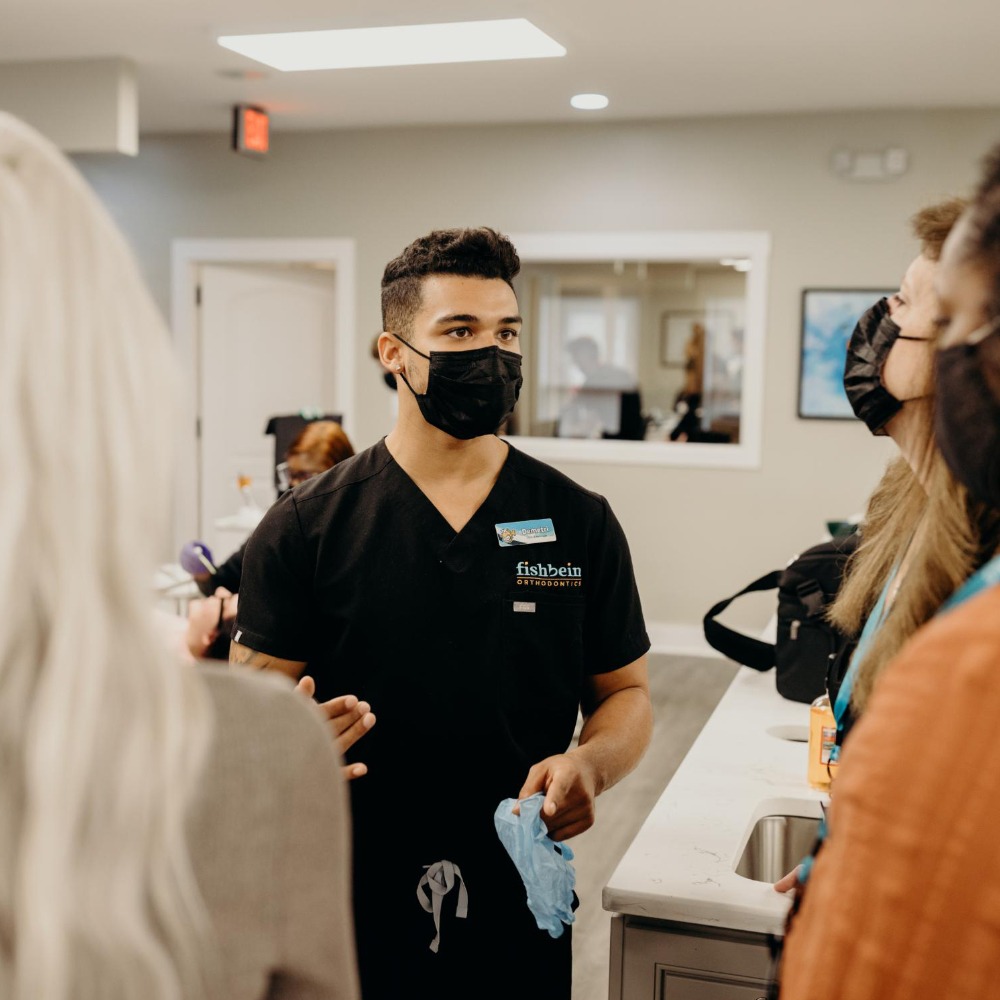
An on-site consulting visit follows a set order. A pre-visit discovery call, morning huddle observation, shadowing of the new patient exam, clinical flow observation, private conversations with team members and leadership, then a closing debrief with prioritized action items. Most visits run one to two full patient days, open to close.
Here’s how each piece works.
1. Pre-visit discovery call and data observation. Before our team travels to your office, we talk. We ask for production numbers, conversion rates, schedule templates, no-show and cancellation patterns, and your goals for the next twelve months. This observation tells us where to point our attention once we’re standing in your office, so day one isn’t spent gathering basics.
2. Arrival and morning huddle observation. We arrive before the first patient. The morning huddle tells us almost everything about how a practice runs. Who speaks, who listens, whether the day is planned or simply survived, and whether the team knows the goal before the doors open.
3. Shadowing the new patient exam. This is where most conversion problems live. We follow the exam from greeting through diagnosis, treatment presentation, and the financial conversation. We listen to word choice, watch handoffs between doctor and coordinator, and note every moment where a parent hesitates.
4. Observing clinical flow and doctor time. Chair turnover, assistant readiness, instrument setup, doctor movement between chairs. Small friction points repeat hundreds of times a month. We track how your doctor time is actually spent versus how it should be spent.
5. Private conversations with team members and leadership. People tell a consultant things they won’t say in a huddle. One-on-one conversations surface bottlenecks fast, and they also reveal which team members are ready to lead a change and which need role clarity first.
6. Closing debrief with prioritized action items. We sit down with the doctor and senior leadership and walk through what we saw, what to fix first, who owns each item, and when it should be done. Priorities come with a timeline. Everything is written down.
Our two-day observations of the everyday process inside your practice give us insight into each department, which lets us build detailed, prioritized action plans for doctors and senior leadership rather than a list of observations.
Benefits of Having a Consultant On Site
Practices tell us the on-site day feels different from anything they’ve tried before. Here’s why.
How Do Blind Spots Get Named?
Teams normalize their own inefficiencies. A three-minute delay at check-in stops feeling like a problem after two years of doing it. An outside observer sees it in the first hour, names it out loud, and connects it to the number on your production report.
Why Does Team Buy-In Happen Faster On Site?
It’s one thing to hear that a new scheduling template will work. It’s another to watch it work in your own office, with your own patients, on a normal Tuesday. When your team sees the change hold up under a full schedule, the conversation shifts from convincing to implementing.
A few more reasons practices choose an in-office observation:
- Coaching happens in the moment. When a treatment coordinator stumbles on an objection, we address it between patients, not in a summary email three weeks later. That immediacy is what makes verbal skills stick.
- Scripting gets tested against real conversations. We refine language based on the objections your patients actually raise, in your market.
- Accountability outlasts the visit. Every action item has an owner and a due date. Change fades without follow-through, so the action plan includes check-in points after we leave.
Practices that visited just a few months ago often come back for a second observation, which tells us the model works. Amanda Floyd, COO of Fishbein Orthodontics, and Dr. Ben Fishbein, orthodontist, still run the practice day to day, so the systems we teach are the ones they use every week with their own team.
On-Site Visit or Virtual Consulting, Which Fits Your Practice?
Both formats work. They solve different problems.
| On-Site Visit | Virtual Consulting | |
|---|---|---|
| Depth of observation | Full patient day observed live, including nonverbal cues and handoffs | Based on reported data, recordings, and screen shares |
| Team engagement | Whole team participates, and culture shifts happen in real time | Usually leadership plus one or two roles per session |
| Travel required | Yes, ours or yours | None |
| Best fit for | Startups, culture resets, stalled conversion, chaotic flow | Ongoing accountability, single-topic coaching, follow-up cycles |
Choose an on-site visit when the problem is systemic. Flat conversion, a schedule nobody trusts, or a team pulling in six directions all require someone in the room. Choose virtual sessions when you already know the issue and need consistent accountability, or when you’re following up on a prioritized plan that’s already in motion.
If the question is less about the visit and more about how you develop people once the plan exists, that’s a separate decision between 1-on-1 and group training.
Most practices do both. An initial in-office observation establishes the action plan, then virtual follow-ups keep the momentum through the next two quarters. Our team works with practices across the country, and the format rarely changes the fundamentals.
Startups and established practices also need different visit structures. A startup needs systems built from zero, pre-opening. An established practice needs existing systems opened up, examined, and rebuilt where they leak.
Is an On-Site Visit Right for Your Practice?
Some practices are ready. Some aren’t yet. Here’s how to tell.
Strong fit if:
- New patient conversion has been flat for two or more quarters despite steady exam volume
- Your schedule feels chaotic, runs late most days, or nobody trusts the template
- Growth has plateaued and you can’t identify a single clear reason why
- You’re opening a startup practice and building systems, roles, and scripting from nothing
- You’ve hired a new treatment coordinator, or turnover has left roles blurry
Weaker fit if:
- Leadership isn’t genuinely open to changing how things are done
- Your team hasn’t been told a consultant is coming and why
- Nobody has time set aside to implement after the visit ends
Readiness checklist before you book:
- You can pull production, conversion, and scheduling data ahead of the visit.
- The doctor is available for the debrief, not squeezing it between patients.
- At least one team member is assigned to own follow-through.
- Your team knows the visit is about growth, not evaluation of individuals.
If you can check all four, you’ll get far more out of a single day than most practices get out of a full year of reading.
Amanda Floyd, COO of Fishbein Orthodontics, and Dr. Ben Fishbein, orthodontist, still run a busy practice every week, which means the hands-on support you receive comes from systems tested daily, not from a slide deck. A full in-office observation, 1-on-1 team member training, and a seat at Fishbein Fundamentals all rest on that same foundation, and our team will help you build something that lasts. Grow your practice and start off strong. We can’t wait to grow with you!
Frequently Asked Questions
How long does an on-site consulting visit last?
Most visits run one to two full patient days, arriving before the morning huddle and staying through the end of the schedule. Two-day visits allow department-by-department observation across clinical, front office, and treatment coordination. Startup practices sometimes need additional planning days before opening.
Should we close the schedule or see patients normally during the visit?
See patients normally. A closed schedule defeats the purpose. In-office visits happen during actual patient days because that’s the only way to observe real flow, real conversations, and real friction. Book your day the way you’d book any other Tuesday.
Who from the team needs to participate?
Everyone who touches the patient experience. That includes the doctor, treatment coordinators, front office and scheduling team, clinical assistants, and whoever handles accounts receivable. Leadership should be available for the closing debrief. The more of your team present, the faster new systems take hold.
What do we receive after the visit?
You receive a written action plan with prioritized items, assigned owners, and an implementation timeline. Recommendations are ranked by impact, so your team knows exactly what to tackle first. Many practices add virtual follow-up sessions to keep accountability strong through the next quarter.
How soon do practices see results?
It varies with how quickly the prioritized plan gets implemented. Scripting changes and huddle adjustments often shift the feel of a day within the first week. Conversion and scheduling improvements typically show up over the following one to two quarters as the team builds consistency.
Do you work with both startup and established orthodontic practices?
Yes. Amanda Floyd Consulting supports startups nationwide from pre-opening through their first year, building systems, roles, and marketing from the ground up. For established practices, we focus on existing systems, team performance, new-patient flow, treatment starts, and accounts receivable. More than 500 practices served across both categories.